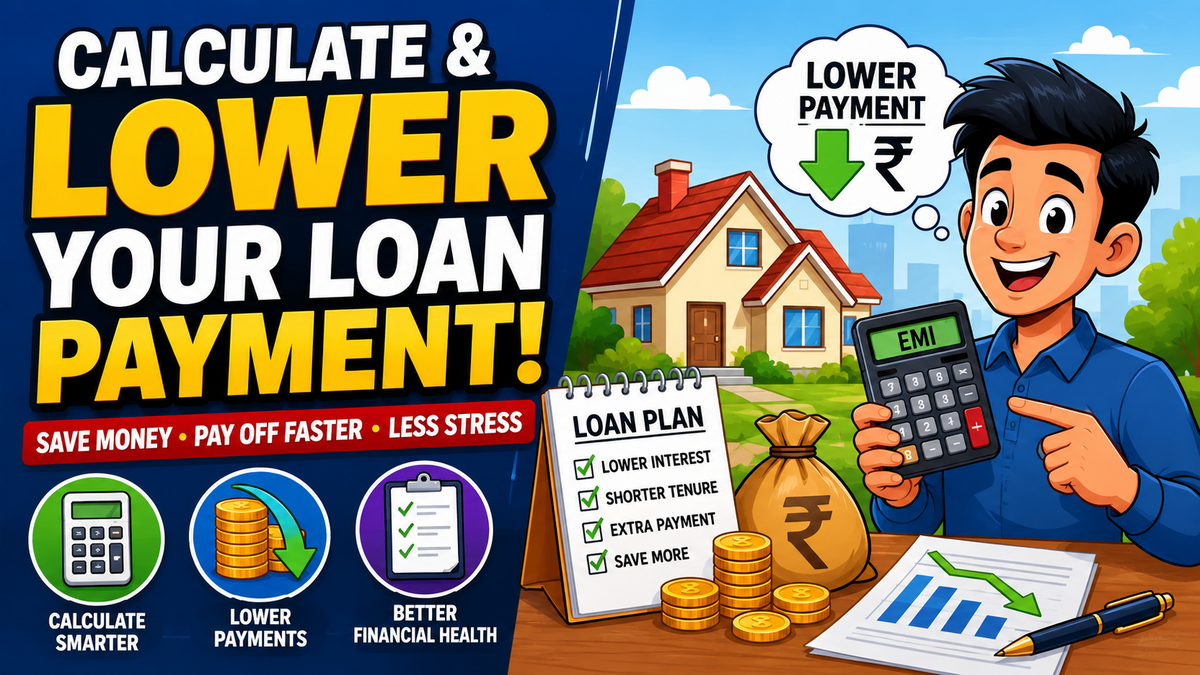
Your monthly loan payment is determined by your total principal, interest rate, and repayment term. Most consumer loans use an amortized structure, meaning your early payments mainly cover interest costs while later payments reduce your main debt balance. Calculating this figure before borrowing prevents unexpected budget strain and helps you spot opportunities to save on overall interest.
How is a monthly loan payment calculated?
Every amortized loan relies on a standard math formula to determine your exact payment schedule. You divide your annual interest rate by twelve to find your monthly rate, then apply that rate across your total term length in months.
Here is the exact loan monthly payment formula:
P = [r * PV] / [1 - (1 + r)^(-n)]
- P is your payment per month.
- r is your monthly interest rate (annual rate divided by 12).
- PV is the principal value or initial loan balance.
- n is the total number of monthly payments.
Suppose you borrow $20,000 at a 6% annual rate for 5 years (60 months). Your monthly rate is 0.005 (0.06 divided by 12). Plugging these figures into the formula gives a monthly repayment of $386.66. You can skip performing this equation manually by entering your numbers into an online EMI calculator.
A common miscalculation occurs when people multiply the annual rate directly by the original principal and divide by twelve. Doing so ignores how principal reductions alter interest math over time, causing people to miscalculate their actual cash flow needs.
Why does your loan payment balance shift over time?
Each monthly loan payment calculator breaks down your installment into two core parts: principal reduction and loan interest payment. Even though your total check stays identical every month, the allocation within that payment changes constantly.
In the first year of a loan, your principal balance is at its highest point. Because interest is charged on the outstanding balance, the lender takes a larger portion of your money to cover accrued interest. As you gradually lower the debt balance, the interest charge drops, allowing more of your fixed payment to hit the principal.
Example: $100,000 Loan at 7% Interest (30-Year Term)
Month 01: Payment = $665.30 | Interest = $583.33 | Principal = $81.97
Month 120: Payment = $665.30 | Interest = $482.40 | Principal = $182.90
Month 360: Payment = $665.30 | Interest = $3.86 | Principal = $661.44
This front-loaded interest setup explains why paying off long-term debts early yields much bigger savings than doing so near the end. If you are financing a residential property, you can check how mortgage schedules split across your tenure using a specialized home loan EMI calculator.
What determines the average monthly loan payment?
The average monthly loan payment depends heavily on loan type, credit evaluation, and chosen term length. Auto loans average around five to seven years, personal loans span three to five years, and home mortgages usually run for fifteen to thirty years.
Three main factors drive your required loan payment per month:
- Principal Amount: The total sum of money you borrow initially.
- Interest Rate: The percentage cost charged by the lender for using their funds.
- Term Length: The duration allocated to pay back the full balance.
A longer term spreads your balance over more installment cycles, lowering your immediate monthly burden. However, a longer term gives interest more time to compound, making the overall cost of borrowing higher. If you are shopping for a new or used vehicle, running your purchase numbers through a car loan EMI calculator helps reveal hidden long-term ownership costs.
How can you lower your monthly payment on a loan?
Lowering your monthly payment on a loan requires modifying one of the core variables in your borrowing agreement. You can decrease the principal balance, secure a lower annual percentage rate, or extend your overall repayment period.
Making a larger upfront down payment directly reduces the starting principal. If you have an active debt, sending extra cash toward the principal balance allows you to request a recast from your lender. Recasting recalculates your installments based on the remaining reduced balance without requiring a full refinance.
Securing a lower interest rate cuts your monthly obligation without lengthening your debt timeline. If market rates decline or your credit score improves significantly, replacing your loan is usually the smartest path forward. If you want to explore other financial utilities or perform different types of planning, you can browse through the full list on ToolsCalculator or check all available web utilities in the tools directory.
If you simply need immediate relief in your cash flow, extending your term length lowers your required outlay. Just remember that pushing payments further into the future raises the overall interest bill.
How do interest rate types change your monthly outlay?
Fixed-rate loans keep your payment identical from your first installment to your last. Variable-rate loans reset periodically based on benchmark market indices, meaning your obligation can fluctuate sharply over time.
When market rates climb, a variable-rate loan automatically increases your interest charge. Lenders adjust your total monthly payment upward so that the loan still pays off on schedule. If you hold a fixed-rate loan, your monthly obligation remains unaffected regardless of broader economic shifts.
If you carry several high-interest debts with floating rates, combining them under a single fixed schedule can stabilize your personal budget. Evaluating your numbers beforehand ensures your new single payment fits comfortably within your monthly budget.
Frequently Asked Questions
Question: How much will my loan payment be on a $10,000 loan?
Your payment depends on your interest rate and loan term. For example, a $10,000 loan at an 8% interest rate over a 3-year term equals roughly $313 per month. Extending that same loan to a 5-year term reduces the monthly figure to approximately $203.
Question: How to calculate monthly loan payment manually?
To calculate loan payment totals manually, divide your annual rate by 12 to find your monthly rate ($r$). Then multiply your loan balance by $r$, and divide that result by $[1 - (1 + r)^{-n}]$, where $n$ represents total months.
Question: Does paying extra money each month lower my required monthly payment?
Making extra payments reduces your principal balance faster, but it does not automatically reduce your fixed monthly bill for future months. Instead, extra payments shorten your total loan duration and lower overall interest unless you officially ask your lender to recast the loan balance.